Beyond BICS: Sweet relief – but only half the story
The British Industrial Competitiveness Scheme (BICS) is open for applications, offering eligible businesses relief on some non-commodity energy bill costs from April 2027 – but what about the commodity costs which can be just as painful, if not more?
If you need a refresher on what BICS is and who is eligible, head over to our recent explainer blog first.
What should businesses do?BICS is here
The British Industrial Competitiveness Scheme (BICS) is here. For eligible businesses nervously eyeing their energy costs, the relief it offers can’t come soon enough – with savings not due to begin until April 2027.
Nor, arguably, do the savings go far enough. British businesses need more, and they need it now – and the place to start is the commodity-cost portion of the energy bill.
Eligible for BICS?
Apply by 30 November 2026 for up to £40 per MWh of relief from April 2027 – and use the wait to tackle the other half of your bill.
The impact of commodity vs non-commodity costs
BICS focuses on certain non-commodity costs. This is the part of the bill which includes things like policy costs and network and infrastructure charges.
Of these, BICS offers up to 100% relief on three of those policy costs. Government estimates put potential savings at up to £40 per MWh on electricity costs.
Renewables Obligation
Up to 100% relief for eligible businesses
Feed-in Tariffs
Up to 100% relief for eligible businesses
Capacity Market
Up to 100% relief for eligible businesses
That’s a substantial saving, and it makes sense for the government to focus on the policy costs which it has a good degree of control over. It also makes sense to address non-commodity costs given that they constitute about 60% of a business energy bill.
60%
Non-commodity costs Where BICS helps
Policy costs, network and infrastructure charges. BICS offers up to 100% relief on three of the policy costs in this part of the bill.
40%
Commodity costs The other half of the story
The unit price of the energy delivered, typically driven by the wholesale energy price. BICS does not touch this part of the bill.
Source: Ofgem, ‘Managing business energy costs in an uncertain market’
But that 60% figure shouldn’t lead businesses to deprioritise the commodity cost portion of the bill, for two main reasons.
A big share of the bill
Commodity costs still account for around 40% of the bill – any savings or extra costs incurred here will make a massive difference to the bill and, potentially, the business’s bottom line.
The key source of uncertainty
Commodity costs can move rapidly and are therefore the key source of uncertainty for businesses with respect to energy bills.
The dangers of energy bill uncertainty
Uncertainty and instability are arguably just as threatening to businesses as high costs. Uncertainty undermines their ability to forecast, plan, hold prices stable for customers and to provide assurance to employees.
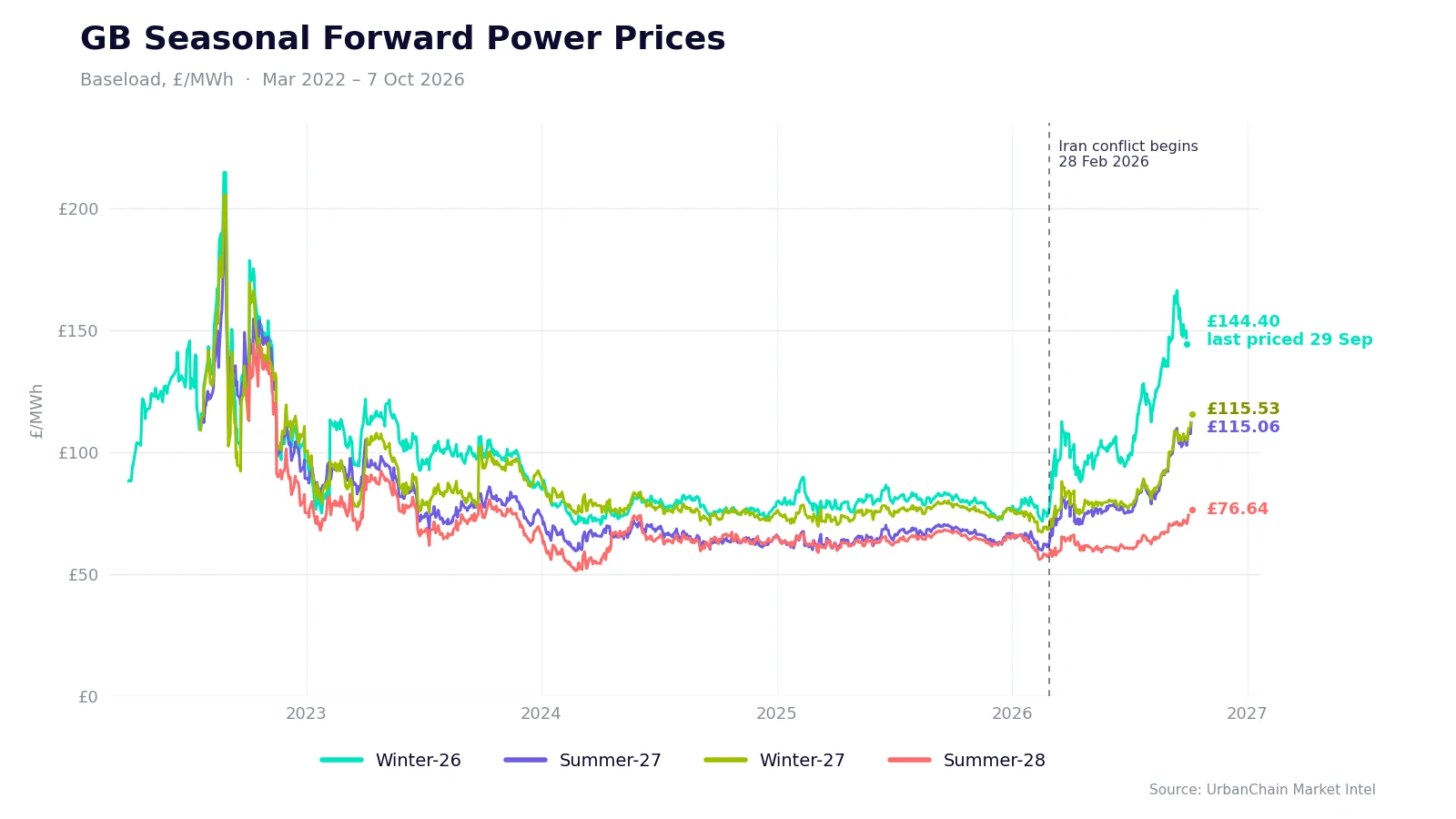
The commodity cost portion of the bill is typically driven by the wholesale energy price, which in recent years has been anything but stable. Extreme weather events, international conflicts and other geopolitical shocks have all proved their ability to rock gas markets, which drive British energy price movements in turn.
Who sets the GB power price?
60% of the time, it’s gas
GOV.UK, ‘Decisive action to break influence of gas on electricity prices’, April 2026
Aug 2022 · Russia invades Ukraine
£511/MWh
GB wholesale power price after Russia’s invasion of Ukraine, against around £73–85/MWh a year earlier.
Q1 2026 · Middle East conflict
+75%
Rise in UK wholesale gas prices between late February and late March 2026, as conflict in the Middle East hit global gas markets.
June 2026 · Heatwave
£1,379/MWh
Paid by Britain’s system operator for emergency imports during the heatwave, around 15 times typical day-ahead prices.
Source: Montel News, June 2026
Therefore, even if commodity costs account for a smaller proportion of the final bill than non-commodity costs, they can have an outsized impact through the uncertainty and volatility they expose businesses to.
Protection from energy bill uncertainty
The most common way for businesses to protect themselves from volatile wholesale energy prices is to sign a fixed contract, which will typically give a steady price for 3–5 years.
However, as we argued in our recent volatility tax guide and webinar, though fixed contracts do provide stability, they do so by pricing in a premium to account for wholesale market volatility. And – given the events of 2026 – any contract signed recently is likely to be pricing in quite a bit of instability. Therefore, businesses taking this option do gain certainty, but still pay for it.
Another effective option is a corporate power purchase agreement (PPA) – a bilateral contract between a business and an energy generator. These are great tools, but they do have their drawbacks and are typically only feasible for large organisations with sophisticated internal resources to dedicate.
| Fixed supplier contract | Corporate PPA | UrbanChain | |
|---|---|---|---|
| Price certainty | Steady price, typically for 3–5 years | Long-term price for the contracted volume | Prices agreed in advance, for the long term |
| Cost of that certainty | Premium priced in for wholesale volatility – likely a large one after the events of 2026 | Shortfalls and surpluses still traded on the wholesale market | No involvement of, or exposure to, the wholesale market |
| Who can access it | Any business | Typically only large organisations with sophisticated internal resources | Any business – like a PPA, but without the overheads |
| Renewable traceability | Depends on the tariff | Linked to a specific generating asset | Named, fully traceable UK renewable generators |
The UrbanChain approach to price stability
Then of course, we have the UrbanChain approach to providing price stability. Our platform matches generators and businesses directly (like a PPA but without the overheads) every half hour, and allows generators and businesses alike to agree and fix prices in advance – all without the involvement of, or exposure to, the wholesale market and its movements.
UK renewable generators
Solar, wind and other renewables
UrbanChain platform
Matches supply and demand every half hour
Your business
Locks in a stable, affordable price
Half-hourly
Direct matching
Our platform matches generators and businesses directly every half hour – like a PPA, but without the overheads.
Fixed
Prices agreed in advance
Generators and businesses alike agree and fix prices in advance, giving long-term certainty.
Zero
Wholesale exposure
All without the involvement of, or exposure to, the wholesale market and its movements.
That’s how one recent manufacturing client, Evtec, has locked in 15 years of price certainty at an affordable rate, entirely from renewable energy.
A long winter waiting for BICS
On the topic of uncertainty – it’s worth noting we’re entering the most uncertain time of the year when it comes to energy prices. Winter is typically when we see the biggest weather-induced spikes in gas demand, on top of greater baseline demand.
This may be cause for concern for any businesses which are particularly vulnerable to wholesale market price spikes. Even if BICS offers some much needed relief, it only begins to take effect from April 2027, with full savings only from next October.
-
Winter 2026/27Now
Peak price risk
Biggest weather-induced spikes in gas demand, on top of greater baseline demand.
-
30 Nov 2026
BICS applications close
One application a year covers all of a company’s sites.
-
April 2027
BICS relief begins
Savings start to take effect for eligible businesses.
-
October 2027
Full BICS savings
Full relief only arrives almost a year from now.
Is your site eligible for BICS?
Check the criteria in our BICS explainer.
Apply by 30 November 2026
One application a year covers all of a company’s sites.
Is your energy price fixed today?
Relief from April 2027
Up to £40/MWh off three policy costs – but commodity costs, around 40% of the bill, are untouched.
You’re exposed to the wholesale market now
Especially important to act ahead of winter.
Check what you’ve locked in
Your rate may include a volatility premium. When does it renew? Renewing this autumn?
Tackle both halves of your bill
UrbanChain can help assess whether there is a better business energy procurement approach available that provides affordability and stability, while also supporting on a BICS application.
Speak to one of our experts
How Evtec Group fixed its price for 15 years
Evtec Group, a tier 1 supplier in a large UK supply chain, needed long-term energy price stability but was structurally blocked from getting it. Through a private market on UrbanChain’s platform, it now buys renewable power matched every half hour, independently of wholesale prices.
15 yr
Locked-in pricing
100%
Generation matched via private market
72%
Renewables, and increasing over time
10,027 MWh
Energy matched Jan–Apr 2026
Key takeaways
What are commodity and non-commodity costs in my energy bill?
Commodity costs are the price of the unit of energy delivered. They fluctuate with the wholesale market (though you can fix them). Non-commodity costs are the charges added to cover things like delivering the energy, running the grid and funding government policies. These are mostly regulated and published in advance, so they are more predictable.
What costs does BICS help with?
BICS will provide partial or full exemption from three specific policy costs (non-commodity costs) – the Renewables Obligation (RO), Feed-in Tariff (FiT) and Capacity Market. This could provide up to £40 per MWh of relief to eligible businesses. However, relief will not take effect until April 2027.
What can I do while waiting for BICS?
Businesses can explore other ways of reducing their energy bill or finding price certainty. This can be done at any time, but is especially important ahead of winter for any business without a fixed contract or with any residual exposure to the wholesale market.
How can UrbanChain help?
UrbanChain’s platform matches generators and businesses directly every half hour, and allows generators and businesses alike to agree and fix prices in advance – all without the involvement of or exposure to the wholesale market and its movements. This is how we deliver affordable, stable renewable energy.
Talk to us about your energy costs
Tell us a little about your business and one of our experts will be in touch to talk through how to make your energy costs more affordable and stable – and to support you with a BICS application.
Choose an option above to get started.
Choose a topic above to get started.
Related reading



TAKE CONTROL OF
YOUR ENERGY COSTS
Affordable, stable renewable energy now – and support with your BICS application.